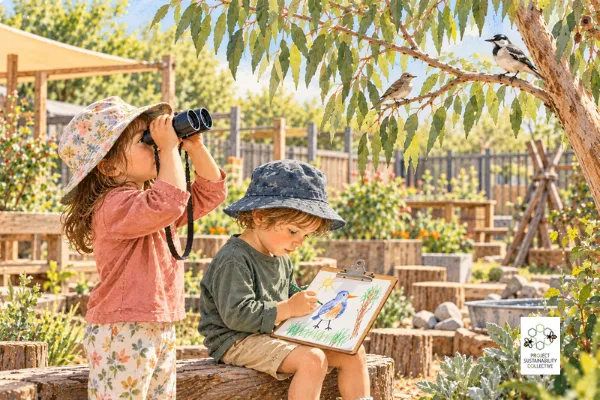
Beyond the Bird Count: Following Children's Curiosity into the Ecology of Place
Events like the Aussie Bird Count offer educators a wonderful opportunity to connect children with citizen science and the living world around them.
Organised by BirdLife Australia, the annual event invites people across the country to spend time observing birds and recording their sightings. These observations contribute to a wider picture of Australia's birdlife, helping scientists and communities understand more about the birds that share our environments.
For children, taking part can be a meaningful way to discover that their observations matter. They can become active contributors to a real scientific project, developing their knowledge of birds while learning that people can work together to understand and care for the world around them.
But there's another opportunity here that's worth considering.
What if the bird count becomes a doorway into exploring the wider ecology of a place?
One observation can lead to another
For some children, an interest in birds might begin with a familiar experience. Perhaps they've watched magpies searching for food in the outdoor play space, heard their calls from a nearby tree, or had a close encounter with a bird swooping overhead.
In spring, stories about swooping magpies and masked lapwings, often called plovers, are common in many Australian communities. These experiences can prompt strong reactions, questions, and sometimes a little apprehension.
Why do some birds swoop? Are they trying to hurt us? Why do they behave differently at certain times of the year? Where are they nesting? What are they protecting?
These are useful questions to explore together. Educators can help children learn that some birds swoop to defend their nests and young, particularly during breeding season. Children can investigate bird behaviour, learn to recognise signs that birds may be nesting nearby, and consider how people can give them space while staying safe.
The inquiry might then take an unexpected turn.
Children could begin wondering what birds need to build nests, where they find food, or why some birds choose particular trees. They might notice insects moving through the garden, discover which plants provide shelter, or start comparing the birds they see in different parts of their outdoor environment.
One observation leads to another question. Each discovery offers another way to understand the living things that share their place.
This is one of the pleasures of place-based learning. A familiar experience, even one that initially causes concern, can become an opportunity to develop knowledge, curiosity and care for the natural world.
From counting birds to understanding relationships
Citizen science offers children an opportunity to contribute observations to a wider investigation. It can also provide a starting point for developing a deeper understanding of the natural world.
As children observe and count birds, they can begin to notice patterns, compare their observations and investigate questions about what they see. They might wonder why certain birds return to particular places, what influences their behaviour or how their surroundings affect the living things they encounter.
These ideas need not be introduced as formal scientific concepts before children have had the chance to explore them. Educators can support children's developing understanding by revisiting observations, encouraging them to share their interpretations and helping them investigate possible explanations.
A question such as Why do you think the birds keep coming back to this tree? can invite children to look more closely, share their ideas and investigate what they think might be happening.
Over time, children can develop their capacity to notice patterns, recognise relationships, gather information and reconsider their ideas in light of what they discover.
They’re learning about birds, certainly. They’re also developing ways of thinking that help them understand the complexity and interconnectedness of the world.
Exploring the ecology of place
The living things children encounter are part of a much wider web of relationships. As their questions develop, so too might their understanding of the place where they live.
Consider some of the directions an inquiry that begins with birds might take.
Living things and their relationships
Children might investigate the insects that pollinate flowers, the plants that provide food and shelter, or the relationships between birds and other animals. They could explore how living things depend on one another and what happens when something in that ecosystem changes.
Habitats and environmental change
Questions about where birds live might lead to an exploration of local habitats. Children could compare a planted garden with a nearby reserve, investigate the effects of removing trees, or consider how water, shelter and food influence the animals that can live in a place.
People and place
Children might discover that their families have different experiences of the local environment. Some may know where particular birds nest, while others might recall birds from places they have lived or visited. Families can contribute observations, stories and knowledge that broaden the inquiry.
Culture, history and traditions
A bird or a particular landscape might lead to questions about how people have known, named, represented and cared for the place over time. With appropriate guidance and relationships, educators can explore local First Nations knowledge and perspectives, recognising the continuing connections of Traditional Custodians with Country and the importance of learning from knowledge holders in ways they consider appropriate.
Children might also discover how local places have changed, how people have used them and which stories or traditions remain connected with them.
Community and collective action
As children become interested in local birdlife, they might discover community gardens, conservation groups, habitat restoration projects or other local initiatives. They may begin to see that people can contribute in different ways to caring for the places and living things they value.
None of these directions needs to be planned in advance. They are possibilities that may emerge as children become more familiar with their surroundings and develop new questions.
The educator's role is to remain attentive to those possibilities and help children explore the connections that matter to them.
Seeing sustainability more broadly
Sustainability is often introduced in early childhood settings through familiar practices such as gardening, recycling, and caring for animals. These experiences can be valuable, but sustainability offers a much wider lens through which to understand our relationships with the world.
An inquiry that begins with birds can open up environmental questions about biodiversity and habitat. It can lead to social questions about how people share and care for places, cultural questions about knowledge and relationships with Country, and economic questions about how communities make decisions about land, resources and development.
It can also create opportunities to explore leadership and governance. Who makes decisions about local green spaces? How are places cared for? How might children and communities contribute their perspectives to decisions that affect their environments?
These explorations can help children develop a sense of agency and citizenship. As they share their observations, express their ideas and contribute to decisions or actions, they begin to recognise that their perspectives matter and that they can make a difference to the places they share with others.
These dimensions are interconnected. A decision about a local habitat, for example, can affect wildlife, community access, cultural relationships and the use of resources.
Educators do not need to cover every dimension in every inquiry. Nor do they need to turn every observation into a sustainability lesson.
The opportunity is to recognise when children's questions open up a chance to explore sustainability in a meaningful way, helping them develop an increasingly connected understanding of the world they inhabit.
The educator's role: noticing what matters
Following children's curiosity does not mean leaving learning entirely to chance. Educators bring their own knowledge, perspectives and professional judgement to the inquiry.
Their role includes noticing what captures children's attention, listening carefully to their questions, interpreting what might make an observation significant and identifying opportunities to extend the investigation.
Educators draw on their knowledge of children, their environment and sustainability to consider which questions might be worth pursuing, what knowledge could help extend the inquiry and what opportunities might support children to develop their understanding.
Sometimes this might mean introducing a useful resource or finding someone who can contribute specialist knowledge. At other times, it might involve revisiting a photograph, comparing observations made on different days or simply allowing more time for children to watch and wonder.
These moments can provide opportunities to strengthen children's understanding of sustainability.
A useful question for educators to ask themselves is:
Why does this matter from a sustainability perspective?
The question encourages us to look beyond the activity itself and consider what children might be coming to understand about living things, relationships, place and their own capacity to contribute.
It also applies to educators' own learning. As we become more familiar with a place, our knowledge can deepen and our attention can shift. We begin to notice connections that we may have overlooked before, opening up new possibilities for the children alongside us.
Seeing sustainability in the everyday
Recognising the sustainability possibilities within an everyday experience takes practice. We might see children watching birds, tending a garden or investigating an insect, but the wider significance of these experiences isn’t always immediately apparent.
The Seeing Sustainability Field Guide offers a way to look more closely. Using five dimensions of sustainability as a lens, it helps educators recognise connections that might otherwise go unnoticed and consider what makes an experience significant from a sustainability perspective.
The aim isn’t to turn every encounter into a planned sustainability activity. It’s to develop our capacity to recognise the possibilities within children's interests and respond in ways that expand their understanding.
Where might your bird count lead?
The Aussie Bird Count provides a ready-made opportunity to engage children in citizen science. It offers a reason to slow down, observe carefully, and contribute to a shared investigation.
What happens next is where things become interesting.
The bird count can become the beginning of a much longer process of coming to know a place. As children revisit their observations, follow their questions and discover new relationships, their understanding can grow in directions that neither children nor educators anticipated at the outset.
Our role is to give those questions time, help children make connections and recognise the significance of what they are discovering.
So, if you are taking part in the Aussie Bird Count, consider this:
What are the children noticing beyond the birds?
What questions are beginning to emerge?
And where might those questions lead you together?
Sometimes, the smallest observation opens up a much bigger world.
Want to develop your sustainability lens?
The Seeing Sustainability Field Guide helps early childhood educators recognise the sustainability connections within everyday experiences and explore what makes them significant for children's learning.
Explore the Seeing Sustainability Field Guide
Find out more about the Aussie Bird Count.


