Blog 9: The Power of Integrated Practice: Where Child Development and Sustainability Meet
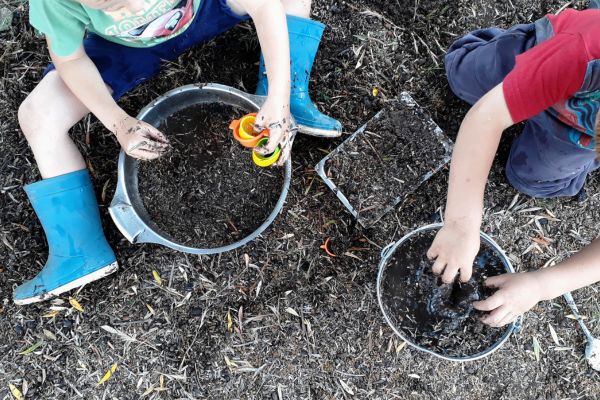
Imagine a group of three-year-olds are creating a "restaurant" in your outdoor area. They're using mud pies as food, leaves as plates, sticks as utensils. The play has been going for twenty minutes, completely self-directed, deeply engaged.
What's happening here?
If you view this scene through a traditional early childhood lens, you see language development, social negotiation, symbolic representation, physical coordination, and executive function all developing simultaneously. Quality practice supporting holistic child development.
But something else is happening too. Something that transforms this from good practice into powerful education for sustainability without adding a single thing.
Development Doesn't Happen in Separate Boxes
Children don't learn one domain at a time. As their language advances, they become able to name emotions, so their social and emotional skills develop. As their physical coordination improves, they can manage more complex collaborative projects, strengthening cognitive and social capacities. As they build problem-solving skills, their frustration tolerance increases, supporting emotional regulation.
Development in different areas is interdependent. The brain doesn't organise itself with separate filing systems for motor skills, cognitive skills, and social skills. Instead, it builds integrated networks that support the whole child.
This understanding matters because education for sustainability works the same way. It's not a separate domain to be added on top of everything else. It's integrated throughout children's development when we recognise the connections.
What Integrated Sustainability Practice Looks Like in Early Childhood
Return to those children creating their mud kitchen restaurant. Through a sustainability lens, here's what's simultaneously occurring:
Environmental domain: Children are directly experiencing natural materials, their textures, properties, and possibilities. They're developing sensory relationships with mud, water, leaves, and sticks. They're learning that natural elements can be transformed and used in multiple ways. They're building the foundation for understanding that nature provides resources.
Social domain: They're negotiating roles fairly. They're sharing materials. They're cooperating to create something together. They're practising the collaboration and communication required for collective action on shared challenges.
Economic domain: They're experiencing production and exchange. They're discovering that creating something requires effort and resources. They're learning about value beyond monetary exchange, the social value of creating something to share, the intrinsic satisfaction of making.
All three domains of sustainability are present in this single play experience. You're not teaching about sustainability. Children are living within systems and developing understanding through direct experience.
The Difference Integration Makes in Early Childhood Education
Traditional approaches to sustainability education often treat it as content to be delivered. Lessons about recycling. Activities about saving water. Stories about endangered animals. These can be valuable, but they position sustainability as something separate from daily life and practice.
Integrated practice is fundamentally different. It recognises that every experience children have is simultaneously developing their general capacities and their relationship with the living world. The question isn't "How do I add sustainability?" but "How do I become more intentional about the sustainability learning already occurring?"
When you grow vegetables with children, you're not doing a sustainability project separate from child development. You're providing an integrated experience that builds capacities across all developmental domains while simultaneously nurturing environmental consciousness, social cooperation, and economic understanding.
When children observe worms in your compost system, they're not having a science lesson separate from education for sustainability. They're developing scientific thinking through direct observation while discovering their own capacity to positively impact living systems through their actions.
When children engage in open-ended construction play with natural loose parts, they're not choosing between cognitive development and sustainability education. They're building spatial reasoning, creative thinking, and problem-solving while developing sensory relationships with natural materials and understanding that nature provides resources with diverse possibilities.
Understanding Systems Thinking in Early Childhood: Nothing Exists in Isolation
This is one of the most important shifts in thinking that integrated practice requires: recognising that nothing exists in isolation. Everything is connected. Everything is interdependent.
When children water the garden, they're not just completing a task. They're participating in relationships between water, soil, plants, insects, birds, weather patterns, human needs, and seasonal cycles.
When they collect fallen leaves, they're engaging with decomposition, nutrient cycling, habitat provision, and seasonal change.
When they observe shadows cast by trees, they're noticing the relationship between sun, time, seasons, energy, and the living things that create those shadows.
Your role is to help children become increasingly aware of these connections. Not through discussions about ecology, but through noticing, wondering, and investigating together.
"Look how the worms are eating our food scraps. That helps create soil for the plants to grow."
"The birds are visiting more since we planted those plants with the flowers. I wonder what they're finding there?"
"Notice how the rain made puddles in our outdoor area. Where did the water go?"
These simple observations draw attention to interdependence. They support children to develop systems thinking, the capacity to understand how different elements relate to and affect each other.
Your Existing Early Childhood Practice Is the Foundation
Here's what matters: you don't need to overhaul your program or add new activities. You need to view what you're already doing through an integrated lens.
That nature table where children arrange and rearrange materials they've collected? It's supporting classification skills, aesthetic appreciation, and fine motor development. It's also building direct sensory relationships with natural materials and modelling that elements from nature are worth protecting, observing, and valuing.
That daily outdoor time where children engage in self-directed play? It's supporting gross motor development, social skills, and creativity. It's also providing the direct experiences with weather, seasons, and living things that form the foundation for lifelong nature connection.
That vegetable garden where children help plant, water, and harvest? It's building responsibility, patience, and scientific observation. It's also teaching about production, interdependence, and the relationship between human actions and living systems.
The difference is in your awareness and intention. When you recognise that these experiences are simultaneously supporting child development and sustainability consciousness, you make different choices about how to facilitate them.
You protect longer periods for outdoor play because you understand the integrated learning occurring there. You invest in natural materials and living things because you recognise their unique contribution to holistic development. You slow down to notice and wonder alongside children because you see these moments as opportunities for building both cognitive skills and environmental stewardship.
The Language of Integrated Practice: Intentional Communication in Early Childhood
Integrated practice also involves intentional language shifts. The words we use shape how children understand their relationship with the living world.
Instead of: "Let's go play outside" (positioning outdoor as a location for an activity) Try: "Let's see what's happening in the garden today" (inviting observation and relationship)
Instead of: "Don't touch that, it's dirty" (teaching fear of natural materials) Try: "That mud is wet and cool. How does it feel?" (inviting sensory exploration)
Instead of: "We need to save the environment" (positioning nature as separate and fragile) Try: "We're part of this place and we help take care of it" (emphasising connection and agency)
Instead of: "Look at that poor dead bird" (focusing on loss and sadness) Try: "That bird has died. I wonder what will happen to it now?" (opening investigation of natural cycles)
These language shifts are subtle but significant. They model a relationship with the natural world characterised by curiosity, connection, and participation rather than separation, control, or fear.
Place-Connected Learning in Early Childhood Practice
Integrated practice is deeply connected to place. Children need to develop relationships with the specific environment where they spend their days.
This means returning to the same outdoor areas repeatedly so children can observe changes over time. It means noticing which trees lose leaves first in autumn and which don't. It means watching particular birds build nests in spring. It means tracking where puddles form after rain and where they dry up first.
These observations might seem simple. But they're building something profound: a sense of belonging to this place. An understanding that this patch of ground, these trees, these creatures are worth paying attention to. A relationship with a specific location that can later extend to caring about broader ecosystems.
Your outdoor area doesn't need to be extensive. A single tree provides enough complexity for years of observation. The way light moves through its branches. How its appearance changes with seasons. Which birds visit it. What grows beneath it. How shadows cast by its leaves create patterns on the ground.
Place-connected learning is about depth of relationship rather than breadth of exposure. It's about helping children develop intimate knowledge of, and affection for, the specific place where they are, rather than abstract concern for distant ecosystems they may never experience directly.
Recognising Holistic Learning Across All Developmental Domains
When you view practice through an integrated lens, you begin to recognise the rich learning occurring in moments you might have previously overlooked.
A child digging in damp soil is building hand strength for writing. They're also developing sensory awareness of texture and temperature. They're discovering properties of earth and water. They're experiencing themselves as someone who can transform materials through their actions. They're connecting physically with the ground beneath them.
A child watching ants carry food is practising sustained attention. They're building observational skills. They're noticing patterns and sequences. They're discovering that small creatures have intentions and work cooperatively. They're developing respect for non-human life.
A child arranging sticks and stones into patterns is exploring shape, size, and spatial relationships. They're developing aesthetic sense. They're expressing creativity. They're discovering that natural materials have diverse possibilities. They're practising the kind of resourcefulness that sees potential in simple elements.
Every one of these experiences is simultaneously supporting development across multiple domains and nurturing the capacities needed for sustainable futures: curiosity, systems thinking, creativity, collaboration, care for living things, resourcefulness, patience, connection to place.
The Transformation That Follows Integrated Practice
When you embrace integrated practice, something shifts. You stop feeling like you're trying to fit sustainability in alongside everything else. You recognise that quality early childhood practice, when situated in relationship with the natural world, is already the most powerful education for sustainability possible.
This doesn't mean you never introduce new elements. You might add more natural materials to your environment. You might protect additional outdoor time. You might become more intentional about your language. You might create more opportunities for children to care for living things.
But these aren't additions to your practice. They're refinements that strengthen what you're already doing by making the integrated learning more visible and intentional.
The result is practice that feels more coherent. Children's development and their environmental consciousness aren't competing priorities. They're integrated aspects of holistic growth that you're supporting through every interaction, every experience, every environment you create.
This is the power of integrated practice. It transforms how you understand your work without requiring you to become something you're not. You remain an early childhood educator focused on supporting children's development. You simply recognise that this development includes their relationship with the living world and that these relationships form during the same critical window when all their other capacities are taking shape.
You are already working at the intersection where human development and sustainable futures meet. Integrated practice is about recognising this truth and acting accordingly.
Continue Your Learning Journey
Want to hear more about integrated practice? Listen to our complete podcast series "The First 2,000 Days: Building Brain Architecture and Sustainable Futures" available now.
Ready to strengthen your integrated practice? Join other educators in our professional learning programs designed to deepen your understanding and expand your impact.
Book a free Sustainaiblity Practice Assessment and discover the sustainability in your practice, identify your service’s overall sustainability practice profile, and outline clear next steps to guide your planning and leadership priorities.
Frequently Asked Questions About Integrated Practice
What is integrated practice in early childhood education? Integrated practice recognises that children's development happens holistically, not in separate domains. When applied to sustainability, it means every experience simultaneously supports general development and environmental consciousness without adding separate activities.
How do the three domains of sustainability apply to early childhood? Environmental domain: relationships with natural materials and living systems. Social domain: collaboration, equity, and relationships between people. Economic domain: understanding production, resources, and value. All three are present in quality early childhood experiences.
What is place-connected learning? Place-connected learning helps children develop deep relationships with the specific environment where they spend their days. Through repeated observation and interaction with the same outdoor area, children develop belonging, knowledge, and care for that particular place. Connection to place provides the context for children to develop their understanding of complex sustainability concepts.
How can I develop systems thinking in young children? Point out connections in daily experiences: how worms help create soil, how rain supports plant growth, how birds depend on trees. Children develop systems thinking through noticing relationships in their immediate environment, not through abstract lessons.
Do I need to change my whole program to practice integrated sustainability education? No. View your existing practice through an integrated lens. The experiences you already provide, outdoor play, gardening, and nature exploration, are simultaneously supporting development and sustainability when you recognise and strengthen those connections.


