Blog 7: NATURE PLAY & DEVELOPMENT- Why Outdoor Time Isn't Optional
How regular contact with nature supports the whole child
A four-year-old crouches beside a puddle, watching water striders. For 20 minutes, she experiments with different movements, trying to touch one. She's developing motor control, scientific thinking, sustained attention, frustration tolerance, and cause-and-effect understanding. All from a puddle.
This is nature play—unstructured time in natural environments where children direct their own learning through direct experience. Research increasingly shows it's not just pleasant. It's developmentally essential.
Physical Development
Natural environments invite movement. Uneven terrain, slopes, trees, rocks—these features require children to adjust balance, coordinate movements, and judge distances.
Children playing outdoors in naturalistic settings move more than children in manufactured playgrounds. They run faster, jump further, climb higher, and engage different muscle groups (Fjørtoft, 2001). Varied natural surfaces provide proprioceptive and vestibular input crucial for body awareness and coordination.
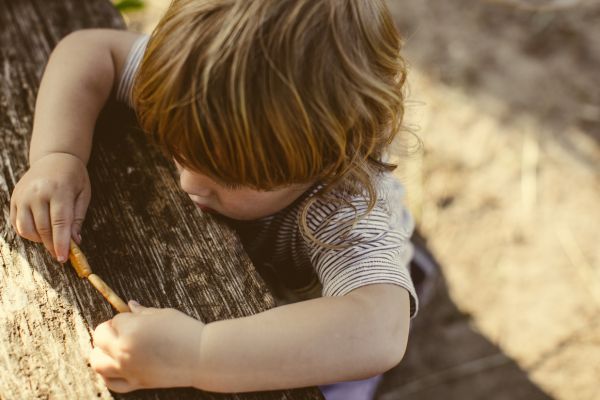
Fine motor skills develop as children manipulate natural loose parts. Picking up small stones, threading grass through bark, building with sticks—these develop hand strength and dexterity in ways plastic toys rarely can.
Cognitive Development
Nature provides "loose parts"—materials that can be moved, combined, redesigned, and reimagined in multiple ways (Nicholson, 1972).
A stick can be a tool, building material, magic wand, sword, boat, or dinosaur bone. This open-endedness stimulates creative thinking, problem-solving, and cognitive flexibility that predetermined toys cannot match.
Natural environments invite scientific thinking. Children observe patterns, test hypotheses, notice cause and effect. They encounter genuine complexity—weather changes, seasonal cycles, animal behaviour—that builds understanding of systems and relationships.
Research from the University of Turku found that outdoor learning in natural settings significantly enhanced children's interest in natural phenomena and supported scientific thinking skills (Kiviranta et al., 2024).
Nature's unpredictability builds executive function. Children adapt plans when it rains, problem-solve when constructions collapse, and negotiate when multiple children want the same stick. These experiences develop cognitive flexibility, working memory, and self-control.
Social and Emotional Development
Natural environments change how children interact. Outdoor play, particularly in natural settings, involves more cooperative play, more complex social scenarios, and longer play sequences than indoor play (White, 2004).
Building a fort together requires negotiating roles, sharing resources, solving problems collectively, and coordinating efforts. These experiences develop collaboration, communication, conflict resolution, and perspective-taking.
Nature provides opportunities for risk-taking and mastery experiences essential for developing competence. Climbing a tree, crossing a creek on stepping stones, these achievable challenges allow children to test limits, develop courage, and experience genuine accomplishment.
Time in nature supports emotional regulation. Natural environments tend to be quieter, less visually overstimulating, and slower-paced. These qualities help children regulate arousal and develop capacity for calm focus.
Australian research confirms that nature play positively affects children's wellbeing, including emotional health, stress reduction, and resilience (AIFS, 2024).
Creativity and Imagination
A stick is just a stick. Until it becomes a wand, fishing rod, walking stick, paintbrush, boat, digging tool, sword, or microphone.
Natural materials invite imaginative play precisely because they're undefined. Children must use imagination to transform them. This contrasts with manufactured toys that often prescribe their own use.
Research shows children engage in more creative, imaginative play with natural materials than plastic toys. The open-ended nature of sticks, stones, mud, and water stimulates rather than constrains imagination (White, 2004).
Not Just Recreation
There's a tendency to think of outdoor time as "break" from real learning, a chance to burn energy before returning to meaningful activities inside.
The research contradicts this. Time in nature isn't a break from development and learning. It's essential for development and learning across all domains.
Physical, cognitive, social, emotional, creative, and language development all occur robustly during unstructured outdoor play, often more robustly than during structured indoor activities.
Quality Matters
Not all outdoor experiences provide equal benefits. Key factors maximise nature play's value:
Regular access. Occasional bushland excursions are valuable, but regular daily access to nearby nature matters more. Consistency allows children to observe changes, revisit favourite spots, and develop ongoing relationships with place.
Adequate time. Brief periods outdoors don't allow for complex, sustained play. Children need substantial time—research suggests at least 60 minutes daily of unstructured outdoor play.
Naturalistic elements. Manufactured playgrounds offer some benefits, but natural features—trees, bushes, gardens, natural ground surfaces, water, varied terrain—provide richer opportunities.
Adult support without over-direction. Educators who provide safety, materials, and engagement without controlling play support development best.
What You Can Do
You don't need bushland:
Incorporate natural elements outdoors: logs, rocks, plantings, varied ground surfaces
Bring nature materials inside: sticks, stones, shells, seed pods, leaves
Protect substantial time for unstructured outdoor play daily, in all weather
Visit nearby natural areas regularly
Observe and document children's rich learning during outdoor play
Why This Matters
The child watching water striders isn't choosing between physical or cognitive or social-emotional development. She's experiencing all of them, integrated and interconnected.
Like a river red gum accessing good soil and water during its first seasons, children provided regular, substantial contact with nature during their grounding years develop robust capacities that will serve them throughout life.
Nature play supports optimal development. It's not optional.
References:
Australian Institute of Family Studies (AIFS). (2024). Nature play and child wellbeing: A rapid evidence review (Alla, K. & Truong, M.).
Fjørtoft, I. (2001). The natural environment as a playground for children. Early Childhood Education Journal, 29(2), 111-117.
Kiviranta, M., et al. (2024). Outdoor learning in early childhood education. Educational Research.
Nicholson, S. (1972). The theory of loose parts. Studies in Design Education Craft & Technology, 4(2).
White, R. (2004). Young children's relationship with nature: Its importance to children's development & the Earth's future. White Hutchinson Leisure & Learning Group.


