We Didn't Set Out to See Learning Differently
There is a point in some journeys when you look around and realise you've arrived somewhere you never expected to be. Not somewhere you didn't want to go, but somewhere you simply didn't know existed when you set out.
That's a little like where we find ourselves now.
Our story began with a podcast. Bron had heard Lil interviewing a guest about nature pedagogy. Sustainability wasn't the focus of the conversation, but something in the way Lil spoke about children's agency and inquiry caught Bron's attention. It led to a conversation, and then to coffee.
We came to that first conversation from quite different places, with different experiences, knowledge and questions. Bron had spent years working across environmental science, sustainability education and engagement, developing and implementing programs and thinking about how sustainability might influence the way people understand and respond to the world around them. Over time, she'd come to believe that early childhood had significant potential to contribute to sustainable futures.
Lil had spent years immersed in questions of pedagogy, play and learning. Her experience with inquiry, curriculum and children's thinking had led her to think deeply about how children make meaning, how their ideas develop and how educators might support that process.
At first glance, those might seem like quite different places to begin, but as we talked, we started to notice how much the questions had in common.
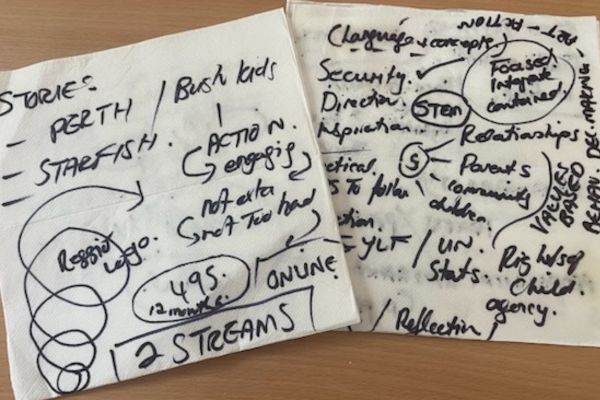
At some point during that first coffee, we took a napkin and started drawing. Ideas went onto the page, along with the approaches, knowledge and experiences we each brought with us. We began mapping where things overlapped, where one idea seemed to connect with another, and where our different perspectives might open up possibilities we hadn't considered before.
The napkin became rather full.
Looking back, it was the first map of what would eventually become Project Sustainability Collective, although of course we had no idea of that at the time. We were simply two people sitting over coffee, following a conversation and trying to make sense of the connections we could see.
There was no strategic plan for where it would lead. We had questions, a conversation and a napkin full of ideas, and that was enough to get us started.
Following the questions
Over the next eighteen months, we brought more of our ideas together, developing approaches and testing them in practice as we worked alongside early childhood services. We were interested in what happened when ideas about sustainability met the complexity of real places, real people and real questions, because that was where we seemed to learn the most.
Some of our attention was drawn to how people might investigate sustainability over time rather than moving quickly from one topic to the next. We wanted to broaden understanding and explore sustainability as something people could use to look at their world, rather than simply as a collection of practices to adopt.
Context kept coming into the conversation too. How could sustainability become meaningful within a particular service or community? What might happen if people began with what mattered in their own place rather than being handed a generic list of things they were supposed to do?
We found ourselves thinking more carefully about listening as well. Not only to the people who were usually expected to provide answers, but to the knowledge, experience and perspectives held across a service and its wider community.
And then there was engagement. We kept asking what might help more people become part of the journey so that sustainability didn't end up resting on the shoulders of one particularly enthusiastic educator or leader.
And underneath all of this, we kept coming back to questions about learning. How does learning actually happen? What helps people develop understanding and capability over time? And what if the ways we were beginning to understand learning could help us think differently about how people engage with sustainability?
We knew that many educators felt they needed to have the answers before they could begin. Sustainability could feel daunting when you believed you needed to understand everything before you were qualified to explore anything.
Yet our experience of children told us something different. Children don't wait until they have complete knowledge before they investigate. They ask questions, test ideas, notice something and return to it. They discover knowledge through encounters with people, materials, places and ideas, often following a question much further than anyone expected at the beginning.
So we began exploring what might happen when educators were able to learn alongside children rather than feeling they had to know everything in advance. That idea of co-research became one part of a much larger body of thinking about engagement, listening, different perspectives, and what it might mean to support people to investigate questions over time.
At that stage, we still had no idea where all those connections would lead. We were simply trying to make sense of the questions in front of us.
Slowly, a story began to take shape
Over time, the pieces started to make more sense together. We developed frameworks and approaches, created programs that allowed us to work with services over longer periods, and continued to learn as those ideas were implemented, adapted, and sometimes challenged by different contexts.
The work kept changing because practice kept teaching us things.
Eventually, we reached a point where we thought we had a coherent story. It wasn't necessarily a finished story, but it felt coherent enough to try to explain.
So we decided to write a book.
We thought we knew what we were going to write. We had the ideas we'd developed, the experiences from our work with services, the examples and stories, and what seemed to be a growing sense of how the different pieces fitted together. Surely, then, the task was simply to put the story on the page.
It turned out to be rather more complicated than that.
Writing made us look again
There is something about trying to explain an idea clearly that exposes the places where your own thinking is less settled than you thought it was. As we began writing, we kept returning to things we thought we'd already worked out.
We'd be explaining one part of our work and suddenly realise it connected with something we'd developed for an entirely different purpose. A question we thought had been answered would come back from another angle. An idea that had seemed self-contained would look quite different when we placed it alongside something else.
The more closely we looked, the harder it became to keep the individual pieces separate.
And then we started seeing those same connections elsewhere.
Bron noticed them in the way the Township Group she was part of was learning and working together. We could see them in the environments and experiences of the services we were working alongside, and Lil began noticing them in other places too, including while spending time with her grandchildren.
The more we looked, the more familiar the pattern became. These connections weren't unique to our work, and they certainly weren't something we'd deliberately created.
They'd been there all along.
We'd simply started to see them.
Something was taking shape
Looking across those different contexts, we began to recognise that certain conditions seemed to be present again and again. They weren't always equally noticeable, and sometimes one appeared to matter more than another, but they seemed to influence one another rather than operating independently.
That prompted another set of questions.
What shapes the way we learn?
What happens when the conditions around learning change?
How does what's around us influence what we notice, what we understand and what becomes possible?
We couldn't see the whole picture yet, but we were beginning to recognise that there was a picture to see.
Learning is ecological
The more we followed those questions, the harder it became to think about learning as something that happens separately from everything around it. Learning seemed to be shaped by the people involved, the place, what had come before, the questions being asked, the knowledge and perspectives present, and the opportunities people had to explore, contribute and make meaning.
We hadn't started out trying to prove that learning was ecological. We'd started by noticing connections, looking again and following the questions that kept returning. Eventually, those questions led us somewhere we hadn't anticipated at the beginning.
Learning is ecological.
And once we began seeing learning this way, it started to change the way we thought about sustainability too. If our aim is to support people and communities to contribute to more sustainable futures, then perhaps we need to pay closer attention to how understanding develops, how capability grows, and what makes that possible in the first place.
We're still exploring those questions.
Perhaps that's the part of the story we find most interesting. We didn't arrive here by following a predetermined plan. We arrived by noticing, questioning, trying things, looking again, and allowing what we discovered to change where we went next.
And that journey continues...
We'd love you to come with us.
Bron and Lil 🐝


