Part 4 | What Do You See First?
What Do You See First?
When someone says the word sustainability, what's the first thing that comes to mind?
Perhaps you picture a garden, composting, recycling or children caring for living things. These are familiar images of sustainability, shaped by our experiences, the people around us, the places we've lived and worked, and the things we value.
They matter. But what else might we be overlooking?
Looking at the same picture
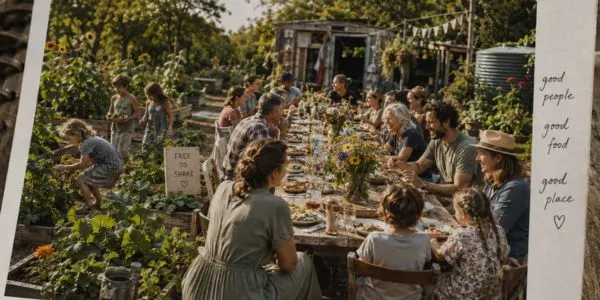
Imagine a photograph of a community garden on a sunny afternoon. A long table sits between the garden beds, with food spread across it and people gathered together, talking and sharing a meal.
What do you notice first?
Perhaps it's the garden, the vegetables growing in the beds, the flowers around the table or the trees beyond it. Perhaps you notice the people or the food instead.
This was the kind of question we'd been exploring ourselves, so we decided to look at a photograph together and see what happened.
As the photograph made its way around the group, people began noticing different things.
Someone pointed to the garden.
“There's sustainability.”
Others nodded. Food growing in the garden, surrounded by plants and trees. Perhaps this was exactly what many of us had expected to see.
But then the conversation began to shift.
Someone noticed the people gathered around the table and wondered about their relationships. Another became curious about the food. Who'd grown it? Who'd prepared it? What had been brought from home, shared or exchanged?
Someone else wondered about the stories and traditions that might accompany the meal. Recipes passed down through families, ways of preparing food that belonged to particular communities, and knowledge gathered and shared over time.
Then came another set of questions.
Who'd imagined the garden? Who'd decided what would grow there? How was the place cared for? What had helped make this gathering possible?
The photograph hadn't changed, but what we could see in it had.
We were looking at the same picture, yet each person had noticed something different. And as those observations came together, the picture began to reveal more than any one of us had seen at first.
What shapes what we see?
We often assume that seeing is straightforward. Something is there, we look at it and we see it.
But our attention is influenced by what we already know, what we've experienced and what we've learned to recognise as important.
Two people can stand in the same place and notice quite different things. One might see a thriving garden. Another might notice a community gathering. Someone else might wonder about the resources being shared, the knowledge that sustains the garden or the decisions that shape what happens there.
None of them is necessarily seeing the whole picture.
And as our understanding develops, our perception can change. We may return to something familiar and begin noticing things that were there all along.
That conversation stayed with us as we continued our journey into the landscape around us.
Another encounter
We hadn't walked far when we heard voices coming from near the creek. Through the trees, we could see people gathered around a long table between raised garden beds.
It was covered with food. Homemade dishes and bowls of salad sat alongside bread waiting to be passed around. Flowers had been arranged in jars along the middle of the table.
Before we'd had much chance to look around, someone spotted us.
“Come and join us,” they called, moving a few bags to make room.
People were sitting wherever there was space. Children and adults shared the table, familiar faces alongside people who appeared to have only recently been welcomed into the community. Stories continued across the table, punctuated by laughter.
Nearby, a group of children raced towards a puddle left behind after the garden had been watered. They lined themselves up, then jumped together, sending muddy water in every direction. One of the adults turned just in time to avoid the spray, and the whole table dissolved into laughter.
We found a place and sat down.
From there, the garden began to reveal more of itself.
The raised beds had clearly been tended with care, although there was nothing particularly manicured about them. Seasonal produce spilled over the edges. A child arrived carrying a basket of tomatoes, proudly announcing that they'd picked them all by themselves. Nearby, another child showed someone something they'd found beneath a pumpkin leaf.
Baskets of fruit and vegetables sat ready to be shared or exchanged. Beyond the table were bee hives, water tanks and a shed with its doors open. Someone was turning a compost heap while bees and other insects moved between the flowers and vegetable beds.
There was a great deal happening around us.
What do you see first?
Perhaps it's the garden, the food or the children playing. Perhaps it's the people who have gathered, the way they welcome one another or the knowledge and care that have shaped this place.
And as we stayed, talked and listened, the different parts of the scene began to connect.
The garden depended on the people who cared for it. The food connected the soil, water, resources and knowledge that had made it possible. The gathering brought together relationships, stories, traditions and decisions that shaped what could happen there.
We'd arrived looking at a garden and a gathering.
We were beginning to see how sustainability was woven through the relationships between people, place, resources, culture and the decisions that shaped what was possible.
Seeing more together
A shift in perception doesn't mean we suddenly understand everything. Often, it begins with recognising that there is more to see.
Someone else's observation may draw our attention to something we'd overlooked. A question might unsettle an assumption we hadn't realised we were making. An experience may help us connect things we'd previously considered separately.
This is one reason it matters to look together.
No one person sees everything. Different experiences and perspectives can help us notice more of what is already there, and perhaps ask different questions about what might become possible.
A way of looking
Over time, we've been developing a way of looking that helps us hold more of this picture in view.
We call it the Sustainability Lens.
The Lens offers five connected dimensions through which we can explore sustainability. It helps us look beyond the practices we readily recognise and become curious about the relationships, resources, knowledge, culture and decisions that shape what happens in a particular place.
We'll explore the Lens more fully as our journey continues. For now, we might begin with a few questions.
What am I seeing?
What else might be here?
What relationships and connections are beginning to come into view?
What is shaping what becomes possible?
We can take these questions into a garden, a classroom, a team meeting, a children's project or a community gathering. We can return to a familiar practice and look again, or listen when someone else notices something we've missed.
The place doesn't need to change before we begin seeing more of what's already there.
When you think about sustainability, what do you see first?
And what might you notice if you looked again?
Take a closer look
Our free Seeing Sustainability Field Guide introduces the Sustainability Lens and its five connected dimensions. It offers prompts to help you notice more, follow connections and explore what sustainability might look like beyond the practices you already recognise.
Begin with an ordinary moment in your own setting and see where your curiosity takes you.
🧭 Explore the Seeing Sustainability Field Guide
Bron and Lil


