Part 2 | What If We Kept Exploring?
There’s a strange thing that can happen when you spend a long time trying to understand something. Eventually, the pieces begin to fit together. Connections that weren’t obvious before become easier to see, and something that’s been taking shape slowly starts to make more sense.
You might think that’s where the story ends.
For us, it wasn’t.
In our previous post, we shared some of the journey that led us to an understanding that changed the way we were thinking about learning.
Learning is ecological.
If you haven’t read that story yet, you can read it here.
Arriving at that understanding gave us a different way to look back across what we’d already been doing. Things that had seemed separate began to make more sense alongside one another, and some of the questions we thought we’d already explored started opening up again.
What did this mean for the way we thought about supporting learning? What might it mean for the way people develop their understanding of sustainability? And what else might we notice if we kept looking?
We didn’t have all the answers, and we weren’t sure where the questions would take us. But that had become part of what we found so interesting. Some of our most useful discoveries had come because we’d stayed with a question a little longer, tried something in another context, listened to someone who saw it differently or returned to something we thought we already understood.
So we found ourselves asking:
What if we kept exploring?
And then another question followed.
What if we invited other people to explore with us?
Making room for other perspectives
By this point, we knew that our own different backgrounds had shaped what we noticed. Bron came to the work through sustainability, environmental science and engagement, while Lil brought years of experience in learning, pedagogy, inquiry and children's thinking. Bringing those perspectives together had changed the way we each understood things.
It made us wonder what might happen when other people brought their experiences into the conversation too.
Because everyone arrives somewhere with a history.
You might have spent years exploring sustainability, or you might still be working out what it means in your setting. You might know a great deal about early childhood learning, but be wondering how sustainability fits with the way you already think about children, pedagogy and curriculum. Perhaps your understanding has been shaped by a particular place, a community, a child, a colleague, a family or an experience that stayed with you long after it happened.
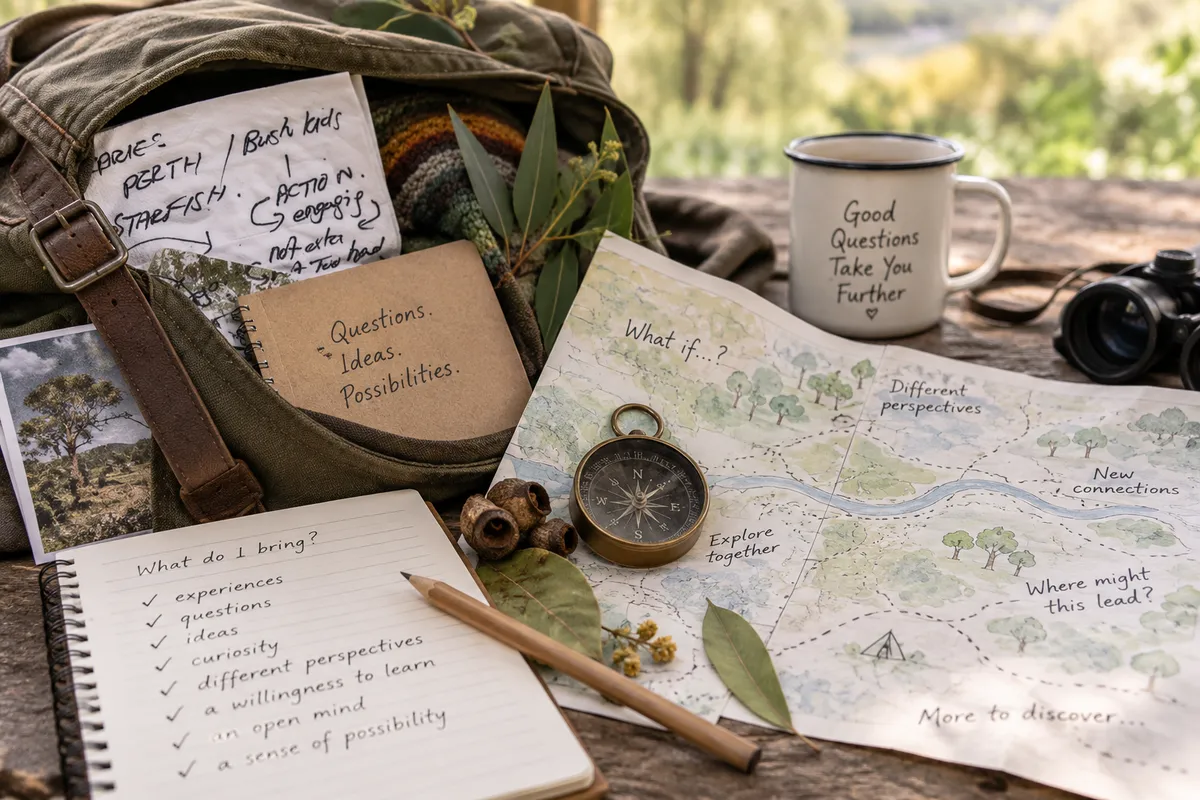
You’ve gathered things along the way too. Knowledge, stories, questions, ideas, interests and observations. You carry them in your backpack, and bring them with you. Some of them are probably things you feel quite confident about, while others may still be sitting somewhere between curiosity and uncertainty.
We’ve come to think that all of that has a place in the conversation.
Sometimes something we’ve been thinking about becomes clearer when we hear how someone else has experienced it. Sometimes a question we hadn’t considered opens up another line of enquiry. Sometimes an idea doesn’t make much sense at first, but sits alongside something else for a while before a connection becomes visible.
That’s one of the reasons we want to keep the conversation open.
There’s more than one way to travel
We also know that people won’t all travel through this journey in the same way.
You might read an email and leave it there for a while. You might listen to a podcast while you’re walking the dog, come across a question on Facebook or LinkedIn that catches your attention, or return to a blog months later when something happening in your own setting suddenly makes it relevant.
The different places we share this work gives us different ways to meet.
Some ideas will make sense straight away. Others may need a little time. You might disagree with something we’ve written, see it from a completely different perspective, or find yourself thinking about a question we hadn’t considered. We’re interested in those possibilities too.
Because if we’ve learned anything from our own journey, it’s that understanding rarely develops in a straight line.
What we bring with us
When we first began working together, we didn’t start from the same place and we didn’t bring the same knowledge, experiences or questions. That difference turned out to be important.
It meant that neither of us was simply reinforcing what the other already knew. We were noticing different things, asking different questions and, at times, seeing something in the other person’s perspective that we hadn’t been able to see ourselves.
That’s changed the way we think about what happens when people come together around a shared question.
You don’t need to arrive already knowing everything about sustainability. You don’t need to have all the answers before you begin, and you don’t need to leave your uncertainty at the door.
Bring what you’ve gathered along the way.
Bring what you know and what you’ve experienced. Bring the questions that keep returning, the things you’ve noticed but haven’t quite made sense of, the stories that have changed your thinking and the ideas you’re still working out.
There’s room for all of it.
So, what if we kept exploring?
We don’t know exactly where this journey will lead.
We didn’t know where our own journey would lead when we sat down with that first coffee and started drawing on a napkin.
What we do know is that some of the most interesting things have happened when different experiences, questions and perspectives have come together and given us something new to notice.
So, we’re going to keep exploring.
And if you’d like to come along, bring your backpack.
We’d love to see what you notice.
Bron and Lil


