Part 3 | What Has Shaped the Way You Understand Sustainability?
Over the last two posts, we've shared a little about how we got here.
We've told you about a conversation over coffee that became a napkin full of ideas, about the time we spent bringing our different experiences and perspectives together, and about the connections we eventually began to notice in places we hadn't expected. We've also shared why, rather than treating those discoveries as the end of the journey, we've decided to keep exploring and invite other people into the conversation.
There's another part of the story we're curious about, though.
How did you get here?
None of us arrives at sustainability from exactly the same place. Our understanding develops over time through the people we meet, the places we know, the experiences we have and the questions that find us along the way. Some of those experiences begin very early in our lives, long before we have words for what we're learning from them.
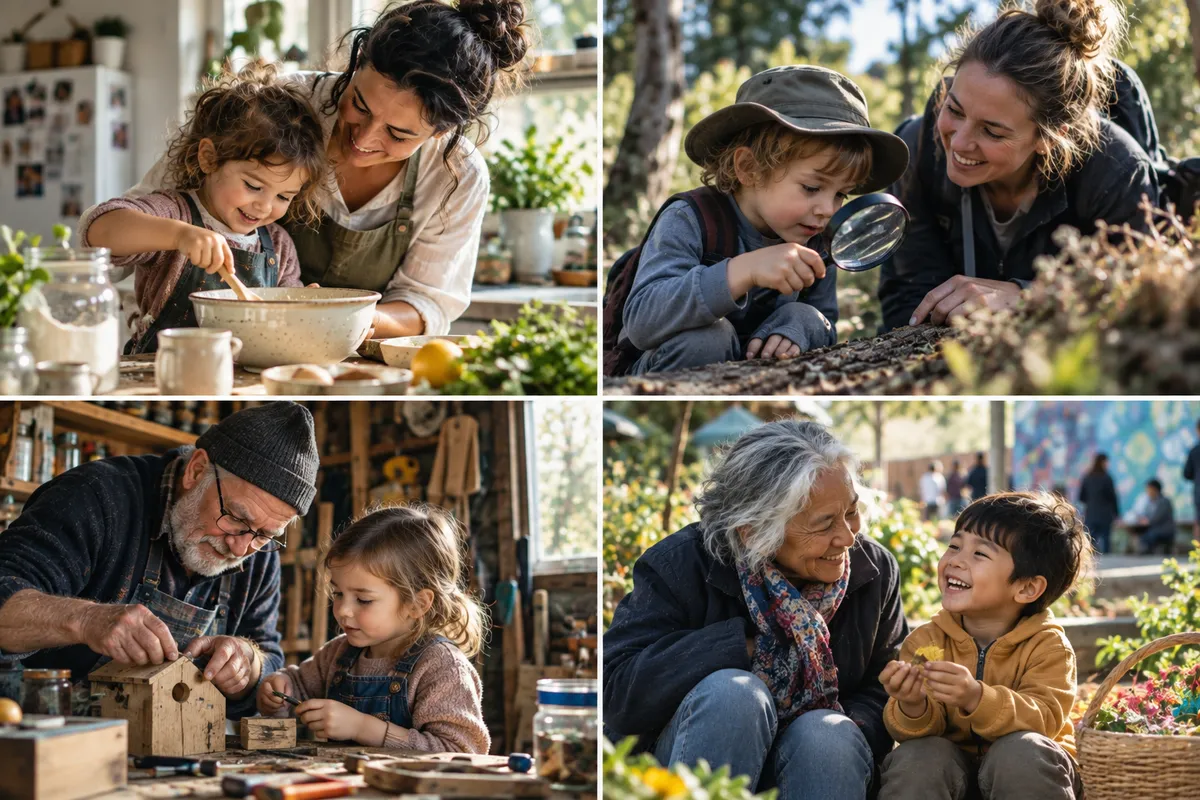
Perhaps you remember jumping in puddles with your siblings or cousins, spending weekends camping, tinkering in a shed with your grandfather, gardening with your nonna, climbing trees or discovering a particular patch of bush that seemed to belong to you. Maybe there was a teacher who encouraged you to look closely at something, a family member who showed you how to grow something, fix something or care for something living.
At the time, none of those experiences may have seemed connected to sustainability. They were simply part of childhood. Yet they can become part of what we carry with us, shaping our relationship with place, with other people, with materials and resources, with living things and with the wider world.
And perhaps that's one of the reasons early childhood matters so much when we think about sustainable futures. The experiences children have now are helping to shape the ways they come to understand themselves, other people and the world they are part of.
We don't always know at the time which experiences will matter later. They become part of the way we see the world, sometimes quietly, until one day we look back and realise how much they've influenced the questions we're asking now.
Your story matters too
When we think about our own journey, there's no single moment that explains how we came to understand sustainability in the way we do today. There are people we've met, places we've spent time in, things we've learned, questions we've carried and experiences whose significance only became clear much later.
Perhaps that's true for you too.
The way you understand sustainability didn't arrive fully formed. It's developed through what you've encountered, noticed, learned, questioned and reconsidered along the way, and it's probably still changing.
You always bring something into the conversation
We've been thinking about this as a kind of backpack.
Not a backpack filled only with knowledge or resources, but everything we carry with us as educators at a particular point in time.
There are experiences in there, things you've learned, questions you haven't answered, skills you've developed. Maybe there're assumptions you may not have noticed you were carrying, people who've influenced us and places that have shaped you. Things you're curious about, worried about, ideas you're holding onto, and ideas you're beginning to question.
Some things have been in your backpack for years. Other things have only just been picked up.
And the backpack is never empty. It changes as you encounter new people, places, ideas and experiences. Something new gets added. Something you have been carrying gets reconsidered. Sometimes you realise that something you thought was essential no longer needs to come with you.
What you carry also influences what you notice.
Two educators can encounter exactly the same experience and take something quite different from it because they arrive carrying different things.
Perhaps this is part of what makes learning with other people so interesting. No one comes to the conversation from a blank page. Each of us carries our own experiences, perspectives, questions and possibilities.
And when those backpacks come together, we have the chance to notice what we each bring, what we might learn from one another and what we might choose to carry forward.
That's one of the reasons we're interested in hearing people's stories. Not only because it helps us understand what someone thinks about sustainability, but because it helps us understand how they came to think that way.
What experiences have shaped your understanding? Which questions have stayed with you? Who has influenced the way you see things? Has there been a person, place or experience that changed what you thought you already knew?
When we start sharing those stories, something interesting happens. We begin to see that we're not all starting from the same place. We may discover experiences we have in common, but we may also encounter perspectives that make us pause, reconsider something or notice a possibility we hadn't seen before.
Both are worth exploring.
A question to ponder
So perhaps this is a good place to pause and think about your own journey.
What has shaped the way you understand sustainability?
Perhaps someone comes to mind. Or a place. A memory from childhood. Something you've learned through working with children. A conversation with a colleague or family. An experience in your community. Maybe even a question that's stayed with you without ever being fully answered.
You don't need to turn it into a neat story or find a particularly profound moment. Sometimes it's only when we stop for a while that we realise how many different experiences have contributed to the way we see the world.
And when we share those experiences with other people, we get the chance to see beyond our own starting point. Someone else's story might help us make sense of something we've been noticing. It might challenge an assumption, open up another question or simply remind us that there are many ways of arriving at the same conversation.
These are the kinds of stories that might be shared around a campfire. Stories about where we've been, what we've noticed along the way, the people who've influenced us and the questions we're still carrying.
That's why we've created a Campfire here at Project Sustainability Collective. It's a place to gather around questions, stories and ideas about sustainability, learning and capability development, and to see what happens when different experiences and perspectives come together.
We've shared a little of our story.
Now perhaps it's worth spending some time with yours.
What has shaped the way you understand sustainability?
Bron and Lil


